EN
EN

Industrial Wastewater Discharge Standards Upgraded Again! How Can Enterprises Break Free from the "Compliance Dilemma"?
* SECCO Intelligent Equipment (Hefei) Co., Ltd. is a wholly-owned subsidiary of Xinyu Technology
"Online monitoring data at the discharge outlet has triggered another warning!" "After the new standards are implemented, the existing processes may hardly ensure stable compliance!" "How to balance the investment and operational costs of upgrading and renovation?"
These are the real anxieties lingering in the minds of countless industrial enterprise managers. In recent years, with the in-depth implementation of the Water Pollution Prevention and Control Law and the continuous improvement of local standards, the "national standards" and "local standards" for industrial wastewater discharge have jointly woven an increasingly rigorous regulatory network. Compliant discharge is no longer a choice, but a mandatory question related to the survival of enterprises.
However, while the standard provisions are cold numbers, the technical challenges behind them are fiery realities. Faced with increasingly tightened limits and more complex regulatory requirements, many enterprises have fallen into a "compliance dilemma" of "passive response and repeated rectification". How to break the deadlock? The key lies in transforming from "passive governance" to "proactive intelligent management" — deeply understanding the logic behind the standards and using innovative technical means to find the optimal solution that balances compliance, cost and efficiency.
01 Standard System: National Standards / Local Standards / Special Emission Limits
China's industrial water pollutant discharge standards form a multi-level system:
1. National Standards (GB): Such as the Integrated Wastewater Discharge Standard (GB 8978-1996) and industry-specific standards (e.g., Water Pollutant Discharge Standard for Food Processing Industry (GB 46817-2025)). These are the bottom-line requirements applicable nationwide.
2. Local Standards (DB): Usually stricter than national standards. For example, in environmentally sensitive areas such as the Yangtze River Delta and the Pearl River Delta, the limit requirements for conventional indicators such as Chemical Oxygen Demand (COD), ammonia nitrogen and total phosphorus, as well as characteristic pollutants such as heavy metals and refractory organic compounds, are much higher than national standards.
3. Special Emission Limits: The strictest requirements implemented for key regions and key industries, which are the focus of current supervision.
Trend Interpretation: The evolution of standards presents two major trends: "the continuous reduction of limit values for conventional pollutants" and "the constant expansion of the list of controlled characteristic pollutants". This means that enterprises not only need to deepen the removal of existing pollutants, but also need to have the ability to monitor and treat new pollutants.
02 Interpretation of Core Indicators and Technical Challenges
To achieve stable compliance, the following major technical difficulties must be overcome:
1. COD (Chemical Oxygen Demand): From "Total Reduction" to "Advanced Removal"
★ Challenge: Especially for refractory COD (such as high-concentration organic components in chemical and pharmaceutical wastewater), traditional biochemical processes are difficult to remove effectively, which may easily lead to fluctuations or exceeding of effluent COD.
★ Technical Direction: Advanced oxidation technologies (such as catalytic oxidation and electrochemistry) or special membrane separation technologies are required for advanced treatment to achieve stable compliance of COD.
2. Ammonia Nitrogen and Total Nitrogen: A "Precise Task" of Biological Treatment
★ Challenge: They are extremely sensitive to conditions such as temperature, pH value and carbon-nitrogen ratio. Improper operation and control may easily lead to the failure of nitrification/denitrification processes.
★ Technical Direction: Precise process control is required. Intelligent dosing and aeration systems can dynamically adjust according to real-time water quality, ensuring the optimal activity of biological flora and realizing stable and efficient removal of ammonia nitrogen and total nitrogen.
3. Total Phosphorus: Combination of Chemical and Biological Treatment
★ Challenge: Single chemical phosphorus removal produces a large amount of sludge, and biological phosphorus removal has strict requirements on operating conditions.
★ Technical Direction: Synergistic biochemical phosphorus removal is the mainstream. The key lies in accurately controlling the dosage of chemicals to avoid secondary pollution or cost waste.
4. Characteristic Pollutants (e.g., Heavy Metals, Fluorides): "Industry-Specific Problems"
★ Challenge: The characteristic pollutants produced by different industries vary greatly (e.g., electroplating industry contains heavy metals, photovoltaic/glass industry contains fluorides), requiring highly targeted and efficient special technologies.
★ Technical Direction: Combined processes such as special adsorption, advanced oxidation and salt separation crystallization are required. For example, for high-concentration fluoride-containing wastewater, a combination of high-efficiency fluoride removal agents and advanced fluoride removal processes is needed.
03 Breaking the Deadlock: From Empirical Operation to Intelligent Compliance
1. Intelligent Early Warning: Turn Passive Response into Active Prevention
★ Current Situation: Enterprises usually take action only after online monitoring data exceeds the standard, which is too late.
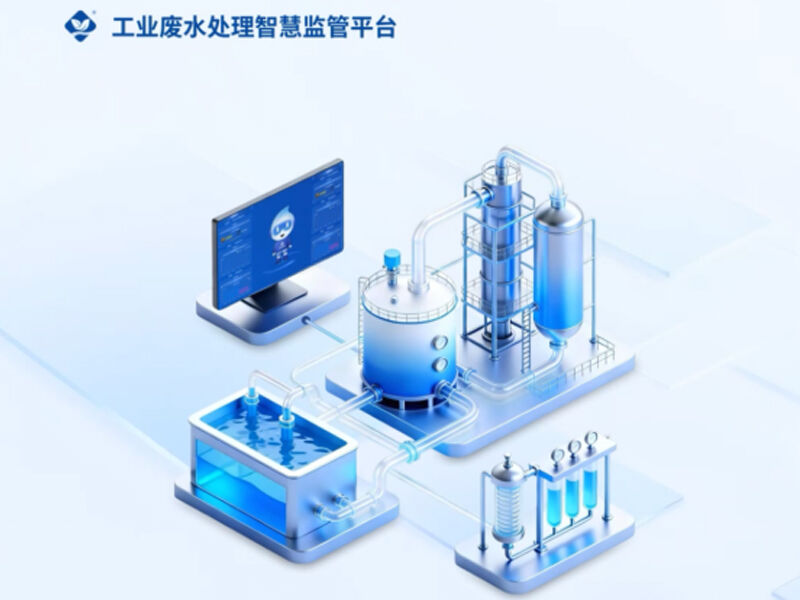
★ Our Solution: By deploying the "Intelligent Industrial Wastewater Supervision Platform", we integrate the full-process water quality and equipment operation data, and use AI models to conduct advanced early warning. The system can predict the risk of effluent exceeding the standard several hours or even longer in advance, and locate potential process abnormalities, gaining valuable adjustment time for operators.
2. Precise Control: Bid Farewell to "Extensive" Dosing
★ Current Situation: Manual dosing based on experience, with varying amounts, not only wastes costs but also affects treatment effects.
★ Our Solution: The intelligent algorithm built into the platform can automatically and accurately adjust key parameters such as dosing pumps and aeration volume according to the millisecond-level feedback of influent load and real-time effluent indicators, ensuring that the process always operates in the optimal state. On the premise of stable compliance, it achieves a significant reduction in chemicals and energy consumption.
3. High-End Equipment: Lay a Solid Foundation for Compliance Hardware
In the face of high standards, reliable hardware is the foundation. SECCO Intelligent Equipment under Xinyu Technology provides solid support for industrial wastewater treatment:
★ High-Standard Pretreatment: For high-salt and high-concentration wastewater, customized pretreatment and resource recovery equipment such as MVR evaporation crystallization are provided to create stable conditions for subsequent biochemical or advanced treatment units.
★ Advanced Treatment Guarantee: Efficient advanced treatment units such as advanced oxidation and special membrane separation are provided, specifically tackling "tough" indicators such as refractory COD and chroma.
4. Ultimate Response: Zero Discharge and Resource Utilization
For enterprises facing strict requirements of "zero discharge" or "near-zero discharge" (such as chemical, electric power and new energy materials industries), Xinyu Technology can provide a full-process resource utilization solution from membrane concentration, salt separation crystallization to evaporation and drying. It recovers valuable components from wastewater, turning waste into treasure and realizing the unification of environmental and economic benefits.
04 Conclusion: Compliance, a Manageable Science
Compliance with industrial wastewater standards should not be a protracted war full of uncertainties. Through an intelligent closed loop of perception, analysis, decision-making and execution, it can be transformed into a predictable, optimizable and manageable science.