 EN
EN


Ministry of Ecology and Environment: Support enterprises to develop green and low-carbon industries and green supply chains, and carry out collaborative innovation in pollution reduction and carbon reduction
On September 14, 2024, the Ministry of Ecology and Environment issued the "Several Measures for the Ecological and Environmental Sector to Further Promote the Development of the Private Economy", proposing 22 measures around five aspects: supporting green development, optimizing environmental access, optimizing environmental law enforcement, increasing policy support, and improving safeguard measures, and put forward specific requirements for the ecological and environmental departments to better support and serve the development of the private economy. propose to speed up the formulation and revision of pollutant emission standards; Support enterprises to develop green and low-carbon industries and green supply chains, and carry out collaborative innovation in pollution reduction and carbon reduction.
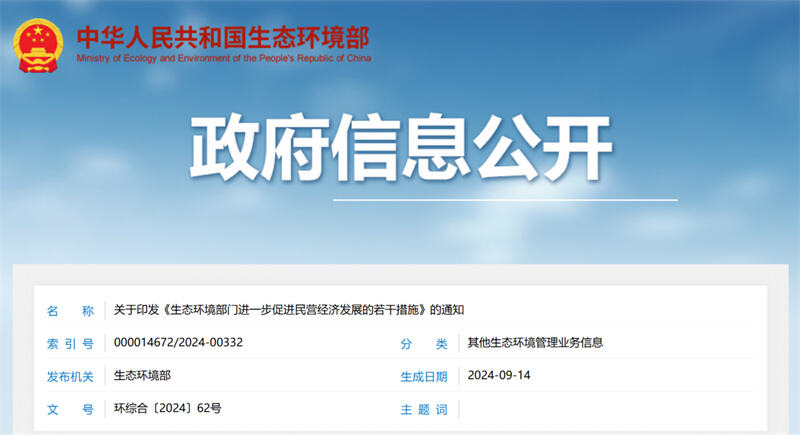
In order to thoroughly implement the decisions and arrangements of the Party Central Committee and the State Council on promoting the development and growth of the private economy, implement the "two unswerving", give full play to the important role of private enterprises in high-quality development, create new momentum and new advantages for the development of the private economy with high-level protection of the ecological environment, and guide the ecological environment department to better support and serve the development of the private economy, the following measures are hereby proposed.
1. Support green development
(1). Promote green and low-carbon transformation. Accelerate the formulation and revision of pollutant emission standards, improve carbon emission accounting standards and technical specifications for enterprises in key industries and project carbon emission reductions, establish a product carbon footprint management system, and guide enterprises to develop green and low-carbon. Support enterprises to develop green and low-carbon industries and green supply chains, and carry out collaborative innovation in pollution reduction and carbon reduction. Promote the green transformation of traditional industries such as petrochemicals, steel, and building materials, and improve the level of cleaner production. Support enterprises to implement clean energy substitution, encourage qualified enterprises to improve the level of clean transportation of bulk goods, and promote the renewal and transformation of internal operating vehicles and machinery with new energy.
(2). Promote large-scale equipment updates. Persist in encouraging advanced and eliminating backwardness, help enterprises investigate backward production process equipment, inefficient and failed pollution control facilities, and actively support enterprises to update and technological transformation of various production equipment, air pollution control facilities, sewage and garbage treatment equipment and other equipment, and promote high-end, intelligent and green industries. Promote the renewal of special equipment for environmental protection, fiscal, tax, financial and other policy support.
(3). Increase the supply of environmental governance services. Promote large-scale recycling and support enterprises to improve the level of waste resource recycling. Improve the environmental infrastructure of industrial parks, promote the development of enterprise agglomeration and centralized pollution control. Encourage areas where small and medium-sized traditional manufacturing enterprises are concentrated to build centralized pollution treatment facilities according to local conditions in combination with the characteristics of industrial clusters. Further improve the collection and treatment system of hazardous waste from small and micro enterprises and social sources, and support enterprises to provide third-party professional services.
(4). Strengthen scientific and technological support for the ecological environment. Carry out in-depth scientific and technological assistance actions to provide technical advice for small, medium and micro enterprises to control environmental pollution. Improve the practical technology management mechanism, solicit advanced pollution prevention and control technologies from the society based on the needs of ecological and environmental governance, encourage private enterprises to actively declare, and accelerate the promotion and application of advanced technologies in enterprises. Rely on the national comprehensive service platform for the transformation of ecological and environmental scientific and technological achievements to provide technical consultation and promotion services for various market entities. Encourage qualified private enterprises to participate in major ecological and environmental science and technology plans and innovation platform construction.
(5). Support the development of environmental protection industry. In conjunction with the "15th Five-Year Plan", a number of major ecological and environmental protection and governance projects will be prepared, a number of major projects for ecological environmental protection and governance will be formulated, feasible technical guidelines for pollution prevention and control and environmental engineering technical specifications will be formulated, and the development expectations of the environmental protection industry will be enhanced. Guide environmental protection enterprises to extend and expand the scope and field of services, and promote the integrated development of ecological and environmental protection industries, energy-saving industries, resource recycling industries, and low-carbon industries. Cooperate with relevant departments to supervise organs, public institutions and large enterprises to perform project contracts in the field of ecological environment in accordance with laws and regulations.
2. Optimize environmental access
(6). Improve the level of administrative examination and approval services. According to the business licensing matters set by enterprises in the field of ecological environment set at the central and local levels, inform enterprises of ecological and environmental protection policies, responsibilities and requirements, as well as the procedures, time limits, contact information, etc. of licensing matters in the form of notices, guidance sheets, etc. Implement the first question responsibility system and the one-time notification service system for the problems encountered in enterprise investment and construction projects.
(7). Continue to deepen the reform of environmental assessment. Implement the "four batches" of EIA reform pilot policies, such as exempting registration forms from filing procedures, "bundling" approval of report forms, and simplifying the content of reports (forms). Promote the management of environmental assessment classification in an orderly manner, standardize the preparation of environmental impact assessment documents, and intelligently assist the approval pilot, and optimize the hierarchical management of environmental assessment and approval. Continue to implement the "three ledgers" and green channel mechanism for environmental impact assessment and approval, open up green channels for major private investment projects that meet the requirements of ecological and environmental protection, and implement immediate reporting and acceptance and transfer assessment to improve the efficiency of environmental impact assessment and approval.
(8). Optimize the management of total indicators. Improve the allocation mechanism of total indicators, and optimize the supervision and management of total indicators of new reconstruction and expansion construction projects. On the basis of strict implementation of various pollution prevention and control measures, construction projects with a single new annual emission of nitrogen oxides, chemical oxygen demand, and volatile organic pollutants of less than 0.1 tons and ammonia nitrogen of less than 0.01 tons are exempted from submitting the source of the total amount index, and the local ecological environment department will coordinate the replacement of the total amount of the index and include it in the ledger management.
(9). Promote the coordinated connection between environmental impact assessment and pollutant discharge permits. For construction projects with relatively simple processes, small environmental impact, and short construction periods, if new product varieties are added but the production process, main raw and auxiliary materials, main fuels have not changed, and the types of pollutants and emissions have not increased, after going through the EIA approval procedures in accordance with the regulations, there is no need to re-apply for EIA, and they will be directly included in the management of pollutant discharge permits. If the construction unit cannot determine whether major changes are involved, it may report to the administrative examination and approval department for verification. For construction projects that meet the requirements, explore the implementation of the "integration of approval" of environmental impact assessment and pollutant discharge permits under the principle of enterprise voluntariness. Coordinate and optimize the classified management of environmental impact assessment and pollutant discharge permits, and some pollution impact construction projects with small emissions are no longer included in the EIA management, but are directly included in the management of pollutant discharge permits.
(10). Strengthen investment policy guidance for construction projects. For the same construction project invested by an enterprise, if multiple administrative licensing matters involve the field of ecological environment, the connection of administrative licensing matters should be strengthened; For those with requirements such as regional layout and scale control, it is necessary to strengthen overall planning and consider the business access permit after the completion of the project in advance, and provide a package of guidance services for the construction and operation of the project.
3. Optimize environmental law enforcement
(11). Implement positive list management of ecological and environmental supervision and law enforcement. Reduce the number of on-site law enforcement inspections for enterprises on the positive list, comprehensively use new technologies and new means, and carry out law enforcement inspections mainly in off-site ways in accordance with the provisions of pollutant discharge permits, so as to disturb law-abiding enterprises. Standardize third-party services for ecological environment management and effectively improve service quality and efficiency.
(12). Continue to standardize enterprise-related fees and fines. Regularly clean up and standardize enterprise-related fees in the field of ecological environment, do a good job in standardizing business service fees and intermediary service fees, promote the management of disguised fees, low quality and high prices, and effectively reduce the burden of enterprise operation. It is strictly forbidden to apportionment to enterprises in the name of ecological and environmental protection. Fully implement the requirements for standardizing and supervising the setting and implementation of fines, and optimize the business environment.
(13). Reduce the number of enterprises filling in forms. Make full use of the existing data of environmental statistics, pollutant discharge permits, environmental assessment and approval, solid waste management, pollution source monitoring and other system platforms, establish a data sharing mechanism, realize data interconnection, promote "multi-table integration", and explore "reporting at most once". Encourage provincial ecological and environmental departments to carry out pilot reforms to reduce the burden of filling in enterprise-related statements.
(14). It is strictly forbidden to "one-size-fits-all" in the field of ecology and environment. Coordinate people's livelihood security and emergency emission reduction, implement differentiated performance classification and control, scientifically and reasonably formulate emergency emission reduction lists for heavy pollution weather, clarify emergency response measures at different early warning levels, and activate and lift heavy pollution weather warnings in strict accordance with the emergency plan. It is not allowed to limit production and stop production in order to suddenly complete the annual environmental quality improvement target. It is strictly forbidden to take simple and brutal acts such as emergency shutdown of work and production, as well as perfunctory response practices such as "all shutdowns" and "stop before talking" in order to deal with inspectors.
4. Fourth, increase policy support
(15). Standardize environmental credit evaluation. Reasonably define the evaluation objects, adhere to the equivalent punishment, and clarify the boundary conditions for the applicable evaluation results. Promote information that is not punished in accordance with the law and that the ecological environment administrative penalty decision before a certain period of time is not included in the scope of environmental credit information. Promote the environmental credit commitment system. Improve the enterprise environmental protection credit repair system, improve the credit repair mechanism, guide enterprises to "correct and revive", and help enterprises "repair as much as possible".
(16). Strengthen financial support. Eligible private enterprise pollution control projects will be included in the ecological and environmental fund project reserve at all levels, and financial support will be given without discrimination. Develop green finance, promote innovation in eco-environment-oriented development (EOD) and other models, accelerate climate investment and financing pilots, and carry out the construction of surplus carbon emission rights (quotas) mortgage mechanisms in a timely manner to solve the problems of difficult and expensive financing for environmental governance of private enterprises.
(17). Implement preferential tax policies. Cooperate with the tax authorities to implement the "Preferential Catalogue of Enterprise Income Tax for Environmental Protection, Energy Conservation and Water Conservation Projects (2021 Edition)", "Preferential Catalogue of Enterprise Income Tax for Comprehensive Utilization of Resources (2021 Edition)" and "Preferential Catalogue of Value-Added Tax on Products and Services for Comprehensive Utilization of Resources (2022 Edition)", as well as extend the preferential corporate income tax policy of 15% for third-party enterprises engaged in pollution prevention and control. If it is not possible to accurately determine whether the project engaged in by the enterprise falls within the scope of the preferential catalogue, it should be studied and promoted in a timely manner.
(18). Support participation in environmental rights and interests transactions. Improve the national voluntary greenhouse gas emission reduction trading market, promote the introduction of more methodologies, encourage enterprises to independently and voluntarily develop greenhouse gas emission reduction projects, and achieve benefits and sustainable development by participating in the national carbon emission rights and national voluntary greenhouse gas emission reduction trading market transactions. Encourage all kinds of enterprises to reduce pollutant emissions through the elimination of backward and excess capacity, cleaner production, pollution control, technological transformation and upgrading, etc., form a "surplus pollutant discharge right", and actively participate in the market transaction of pollutant discharge rights.
(19). Support excellence and pilot demonstrations. Encourage private enterprises to create A-level enterprises with environmental performance and implement relevant incentive policies. Support enterprises to give full play to their own advantages and participate in pilot demonstrations of reforms such as "point-to-point" utilization exemption of hazardous waste, cross-regional transfer management, and the construction of "waste-free groups". Support private enterprises to play a leading role in major regional strategic ecological environmental protection, and the Ministry of Ecology and Environment will establish a platform for displaying typical cases of green development to guide various market players to contribute to building a beautiful China pilot zone.
5. Improve safeguard measures
(20). Improve the working mechanism. Improve the working mechanism of the ecological and environmental departments in the region to promote the development of the private economy, and clearly grasp the leading departments, division of responsibilities and responsible persons for implementation. Strengthen communication with development and reform departments, the Federation of Industry and Commerce, etc., regularly visit and listen to the opinions and suggestions of private enterprises, and smooth the channels for private enterprises to complain and report, reflect problems, and express their demands. For the common ecological and environmental problems reflected by private enterprises, it is necessary to respond quickly and grasp them quickly. Establish a closed loop of "problem collection, problem solving, result feedback, and tracking and effectiveness", and strive to make more private enterprises feel and gain.
(21). Strengthen policy guidance. In the process of formulating and revising ecological and environmental protection regulations, standards and policies, it is necessary to fully solicit opinions from all sectors of society, and do a good job in legality review and macro policy orientation consistency assessment in accordance with relevant national regulations. Strengthen the quality management of the formulation and revision of mandatory standards such as emission standards, formulate implementation plans before the release of standards, and reserve sufficient time for enterprises. Strengthen publicity, interpretation and training of ecological and environmental regulations, standards, and policies, and stimulate the endogenous driving force of enterprises to develop green.
(22). Strengthen publicity and promotion. Strengthen the excavation and summary of advanced models of private enterprises in protecting the ecological environment, timely sort out the good practices and good experiences of ecological and environmental departments, especially the grassroots front-line service, and comprehensively use press conferences, official websites, newspapers, "double micro" and other forms to increase publicity and promotion. Actively respond to the concerns of small, medium and micro enterprises, and take multiple measures to relieve their difficulties. Continue to strengthen the guidance of public opinion and create a strong atmosphere to support the green and healthy development of private enterprises.
Source: Ministry of Ecology and Environment